Table of Contents
Blue Ocean Wine House editorial guide · Reviewed 18 November 2026 ·
Buying whisky or cognac in Malaysia? A genuine-looking box or a low price is not proof of authenticity. Learn how to check Malaysian liquor tax stamps, bottle closures, labels, batch identifiers and the seller's supply chain—and what to do when a bottle appears suspicious.
Counterfeit, parallel-imported and duty-free alcohol: what is the difference?
Counterfeit alcohol is a product falsely presented as genuine—for example, an imitation of a recognised brand or a refilled bottle presented as factory-sealed. It can create serious safety and consumer-protection concerns.
Parallel-imported alcohol generally means genuine branded products acquired through a supply channel outside a brand's designated local distributor network. The term describes a distribution route, not proof of counterfeiting. Whether any particular shipment may be legally sold in Malaysia depends on applicable import, excise, customs, labelling and other requirements. A seller should be able to explain the product's provenance and duty status.
Duty-free alcohol may be legitimately sold under specific duty-free arrangements. That is not the same as an ordinary duty-paid retail bottle. A traveller's personal allowance is not automatically permission to resell bottles commercially; see the Royal Malaysian Customs traveller guidance.
Keep these questions separate: Is the spirit genuine? Was it imported or supplied in compliance with Malaysian rules? Is this seller a trustworthy source? A bottle can answer one question differently from another.
Quick comparison: which checks help, and what are their limits?
| Buyer check | What it can indicate | What it cannot prove | Suggested next step |
|---|---|---|---|
| Seller identity and invoice | Traceable business, purchase record and accountability | Guaranteed authenticity by itself | Confirm seller details, ask for a receipt and written product description |
| Malaysian liquor tax stamp, where applicable | A potential indicator relevant to Malaysian excise-stamp compliance | That the contents are genuine or that every tax rule was met | Compare with current Royal Malaysian Customs guidance; ask about legitimate exceptions |
| Cap, cork and tamper evidence | Possible signs of opening, damage or replacement | Authenticity if the closure looks intact | Check closely in good light; request clear photographs before buying |
| Label and packaging | Printing defects, errors or inconsistencies versus the specific edition | Counterfeiting solely because an older or overseas edition looks different | Compare exact release, market, size and packaging with reliable brand material |
| Batch / lot identifier | Possible traceability information for a brand or distributor | Authenticity from a number alone; not every identifier is publicly verifiable | Ask the manufacturer or authorised service channel if verification is supported |
| QR / security feature | Brand-supported verification on eligible bottles | Authenticity if it only opens a generic webpage or an unrelated domain | Follow the brand's published instructions; inspect the destination carefully |
| Unusually low price | Reason to ask about the source, product condition, market edition and duties | That a discounted or parallel-imported bottle is fake | Compare matching bottle size and edition; ask for documentation |
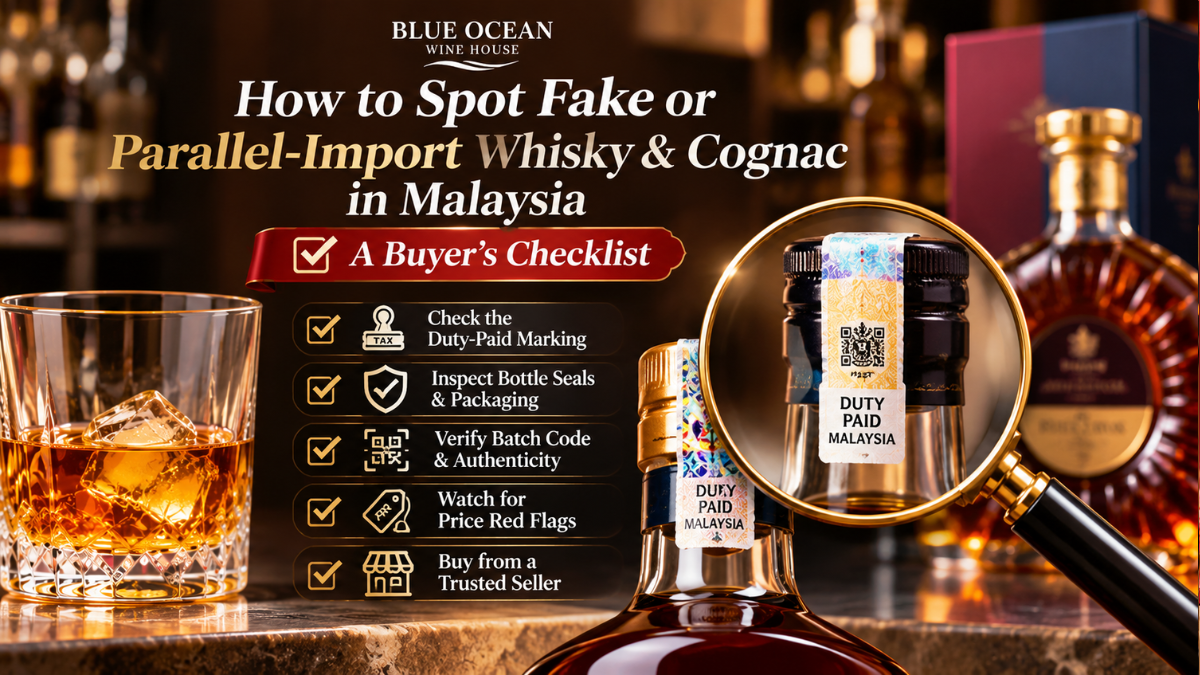
1. Check Malaysian duty-paid markings—without treating the stamp as a guarantee
The Royal Malaysian Customs MyExcise liquor information explains that liquor tax stamps with security features are used in efforts to identify illicit alcohol. Malaysia also operates a Tax Stamp Management System. The official Customs liquor tax-stamp poster documents a stamp design introduced from January 2022.
For an ordinary duty-paid retail bottle, examine whether the tax-marking presentation makes sense for its distribution context and ask the seller to explain it if uncertain. Do not assume that every genuine imported bottle has the same stamp design or that a missing stamp automatically proves counterfeiting: duty-free arrangements, bottle age, packaging and changing stamp programmes can affect the context. Nor should you accept a convincing-looking stamp as proof the liquid is genuine.
Before making a regulatory allegation, consult current Customs guidance or seek confirmation from the relevant authority. An online photograph is not a definitive customs assessment.
2. Examine the bottle, closure, label and batch information
Closures and fill condition
Look for broken or disturbed tamper-evident components, unusual leakage, a badly fitted cap, conspicuous damage around the neck or visible particles. Some product designs and closures differ across release years and export markets, so treat anomalies as reasons to investigate rather than proof of a fake.
Printing and packaging
Check the brand name, expression, ABV, bottle volume, typography, front and back labels, outer carton and gift-set components against the same release and market edition. Avoid relying on a single random product photo: seasonal, travel-retail and updated packaging may look different while remaining genuine. Martell's official FAQ specifically advises checking high-quality, accurately aligned labels, proper seals and a clean, consistent fill.
Batch numbers and serial-style identifiers
A printed or laser-etched code may help a manufacturer or distributor identify a bottle, but there is no universal public batch-code database for every whisky or cognac. Treat missing, rubbed-off or inconsistent codes as questions for the seller or brand—not as a standalone authentication test. Do not enter codes on unofficial sites simply because they claim to verify spirits.
3. Use official brand verification when the brand actually offers it
Martell Malaysia: The brand announced a bottle identification and verification feature for specified duty-paid Martell Cordon Bleu, Martell Noblige and Martell XO bottles, deployed in phases. Its guidance describes a unique QR code and a second check using a three-digit security code. See the official Martell Malaysia announcement. Do not assume every Martell expression, edition or market bottle carries this feature.
Other brands: First locate the official brand website or support channel, rather than scanning a code and trusting whichever site it opens. The Macallan support FAQ contains bottle-authentication and verification questions; contact the brand directly for the procedure relevant to your bottle. The Scotch Whisky Association provides guidance and a route for reporting suspicious Scotch Whisky.
4. Treat unusual prices as a prompt for questions—not a verdict
Compare like with like: the same expression, age statement, bottle size, edition, presentation and sales conditions. A 700ml standard bottle should not be compared uncritically with a 1-litre travel-retail edition or a festive set with accessories. Clearance promotions and different distribution routes can explain some differences; unusually cheap offers combined with poor seller transparency, missing receipts or inconsistent packaging deserve extra scrutiny.
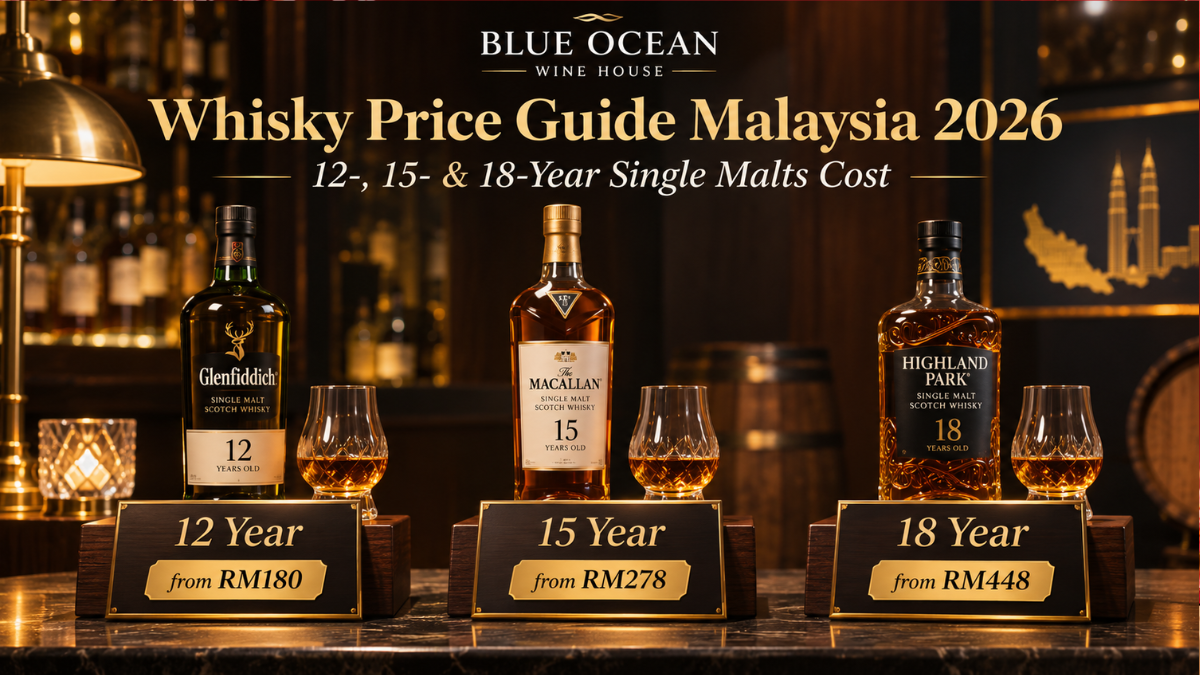
For context, consult Blue Ocean's Whisky Price Guide Malaysia 2026 when published, and compare current product listings. A price guide is a benchmark, never an authentication certificate.
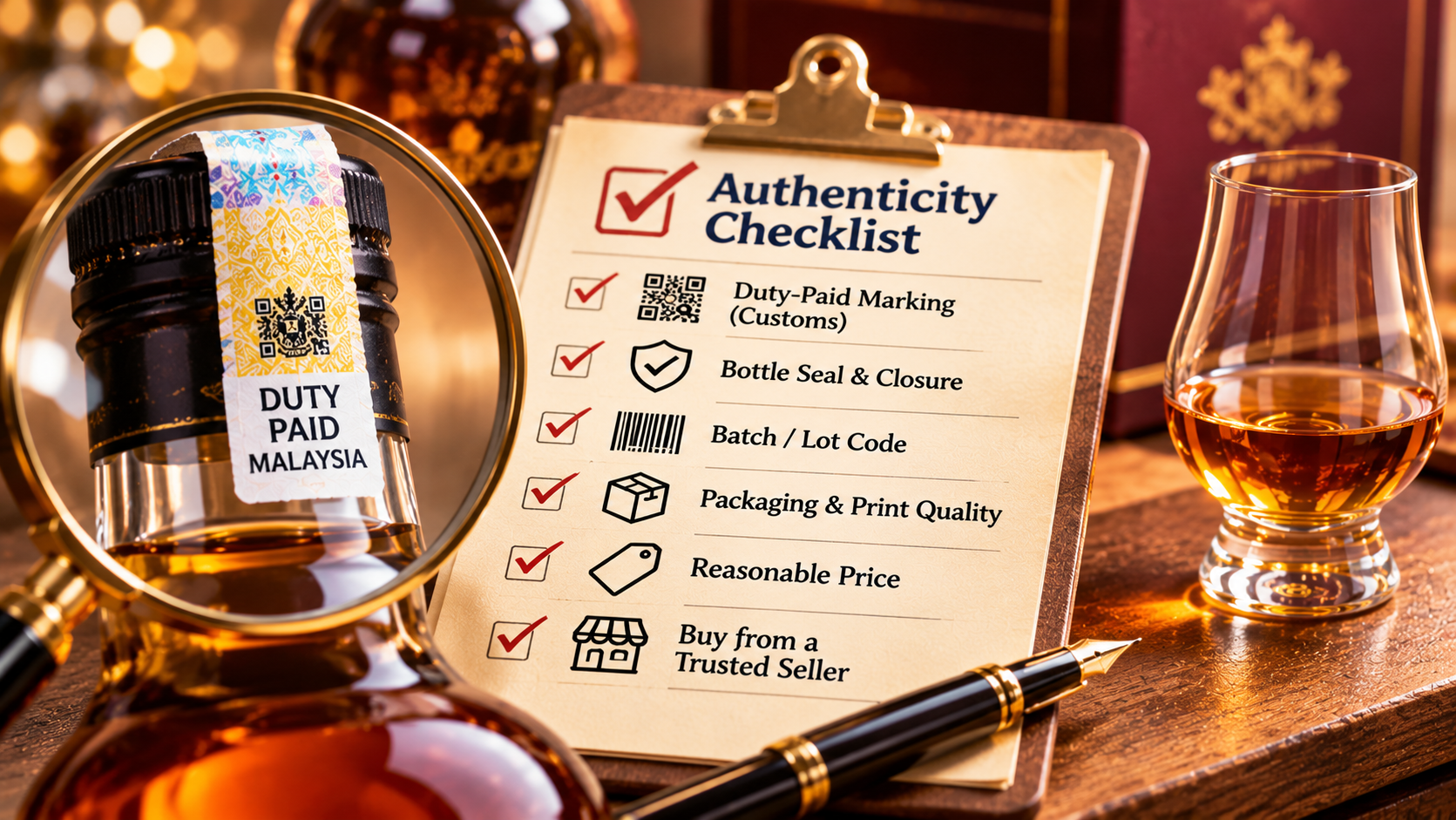
Printable buyer's checklist: 10 checks before you pay
- Confirm the seller's registered business or identifiable retail presence.
- Check whether the seller issues a receipt or invoice with the product description.
- Verify the exact brand, expression, size, ABV and edition advertised.
- Ask if the bottle is local duty-paid stock, duty-free stock or parallel-imported, and what evidence supports its supply status.
- Inspect Malaysian tax markings where applicable; query unexplained discrepancies.
- Check the cap, closure and tamper evidence for signs of disturbance.
- Review label quality and spelling against the same authentic edition.
- Look for batch/lot identifiers and ask how the seller handles verification questions.
- Use an official brand authentication method only when supported for that bottle.
- Keep the invoice, packaging and clear photographs until you are satisfied.
Six questions to ask a whisky or cognac seller in Malaysia
- Is this exact bottle sourced through the local authorised distributor, a parallel import or another documented channel?
- Is it intended for ordinary Malaysian duty-paid retail sale, and can you clarify the tax-stamp status?
- Can you show the actual bottle, including its front/back labels, cap and any security feature?
- Can you provide an invoice and accurate written description of the edition and volume?
- What happens if the brand or relevant authority raises an authenticity concern?
- Will you help contact the importer, distributor or brand for verification when appropriate?
The quality of the seller's answers matters more than a rehearsed promise of “100% original.” A transparent retailer should explain its supply route and escalation process without claiming that a label, tax stamp or code offers absolute certainty.
What should you do if a bottle looks fake?
- Do not open or consume it if you have credible concerns about adulteration or counterfeit contents. Do not taste-test it to decide whether it is safe.
- Photograph the packaging, cap, labels, stamps and any batch/security code. Preserve the receipt and seller correspondence.
- Contact the seller with a precise explanation of the concern and ask for evidence or a resolution.
- Where appropriate, contact the brand's official support channel. For suspicious Scotch Whisky, the Scotch Whisky Association asks for seller identity, location and images.
- For suspected Malaysian customs or excise non-compliance, refer the matter to Royal Malaysian Customs. Avoid publicly accusing a specific seller based solely on appearance.
How Blue Ocean approaches authenticity
Blue Ocean Wine House describes its online range as “100% Authentic Duty-Paid Bottles.” For buyers, meaningful trust comes from traceable product information, a clear explanation of sourcing and responsive after-sales assistance—not from the claim alone. Customers should ask for documentation and clarification whenever they are uncertain about a particular bottle.
Editorial verification required before publication: [Insert Blue Ocean's documented supplier-vetting steps, invoice/traceability policy, customs/tax-stamp inspection practice and complaint escalation procedure. Confirm each operational statement with management.]
Frequently asked questions
Does a Malaysian Customs tax stamp prove a whisky is authentic?
No. A tax stamp may be relevant to excise compliance, but it does not independently prove that the contents were bottled by the brand. Assess seller provenance, packaging and official brand verification together.
Is parallel-import whisky fake?
Not necessarily. Parallel import refers to a supply channel outside a brand's designated local distributor network. A bottle may be genuine, but its import and retail compliance must be considered separately.
Does a bottle without a Malaysian liquor tax stamp have to be counterfeit?
No. The absence of a stamp is not sufficient to determine authenticity and may require investigation of the product's age, distribution or duty-free status. Ask the seller for details and consult Customs when necessary.
Can a QR code confirm that Martell cognac is genuine?
For certain eligible duty-paid Martell Cordon Bleu, Noblige and XO bottles, Martell Malaysia has described a QR-and-security-code verification feature. Follow the brand's official instructions; do not assume the system applies to every Martell bottle.
Can a batch code alone authenticate a bottle?
No. Batch and lot codes can assist traceability but are not a universal consumer authentication method. If a code raises questions, contact the manufacturer or official service channel.
What if whisky is much cheaper than other Malaysian sellers?
Ask whether the product has a different bottle size, edition, promotion or supply route. A low price is a warning sign only in context, particularly when accompanied by unclear seller details or inconsistent packaging.
Primary sources and methodology
This guide synthesises publicly available guidance and buyer checks. It does not substitute for inspection by customs authorities, the brand owner or a qualified laboratory. Source review date: 18 November 2026.
- Royal Malaysian Customs / MyExcise — Liquor (tax stamps and illicit-liquor context).
- Royal Malaysian Customs — Tax Stamp Management System 2.0 (current tax-stamp programme portal).
- Royal Malaysian Customs — liquor tax stamp poster (historical design notice; not proof of current appearance).
- Royal Malaysian Customs — Travellers' Guide (traveller allowances and duty-free context).
- Martell Malaysia — Bottle Identification and Verification Feature (eligible bottles and QR/security-code process).
- Martell — Official FAQs (general bottle authenticity checks).
- The Macallan — Official General FAQs (verification-support topics).
- Scotch Whisky Association — Help Us Protect Scotch Whisky (recognising/reporting suspected fakes).
For adults aged 21 and above in Malaysia where legally permitted. Never consume suspected counterfeit or adulterated alcohol. Drink responsibly; do not drink and drive.